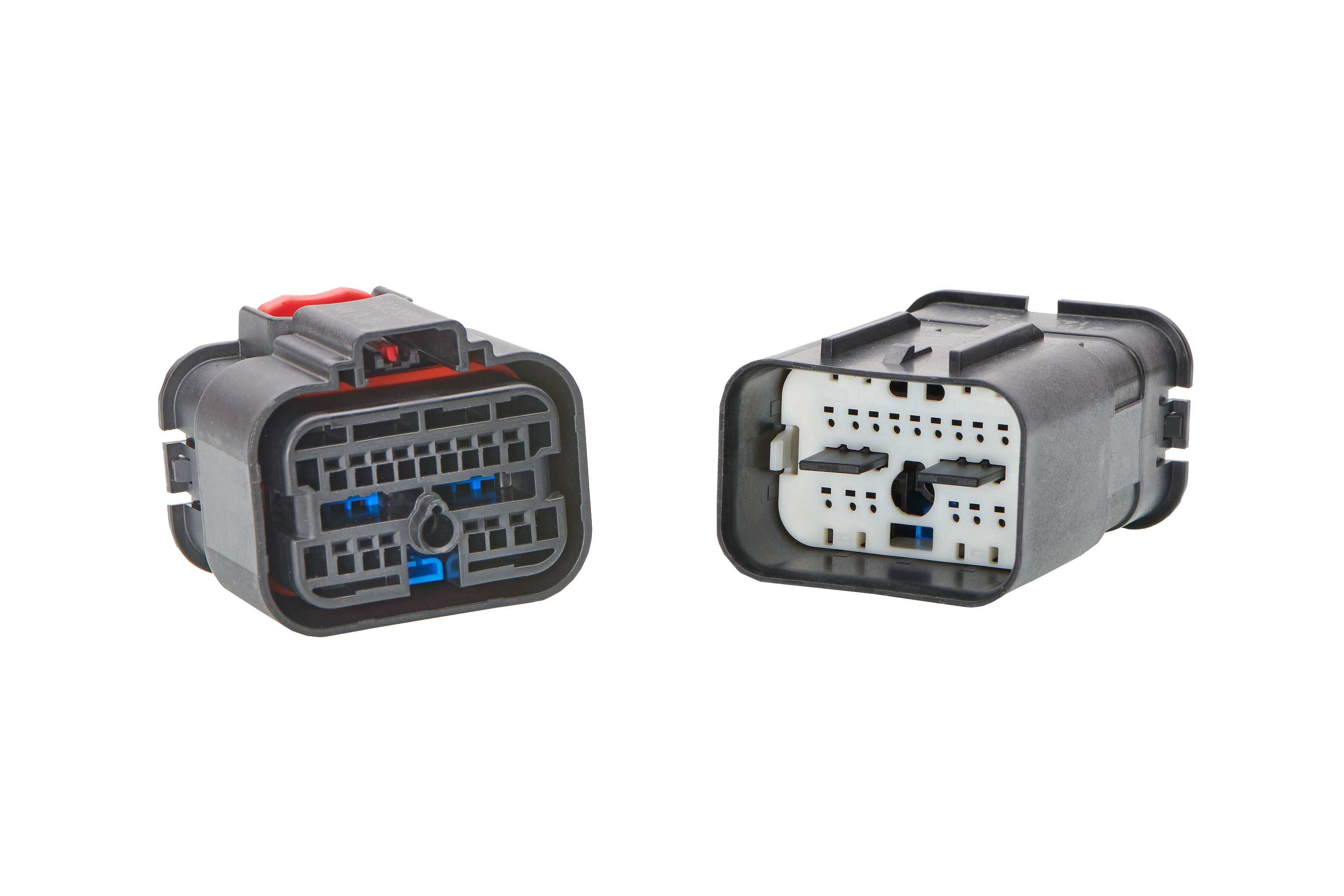
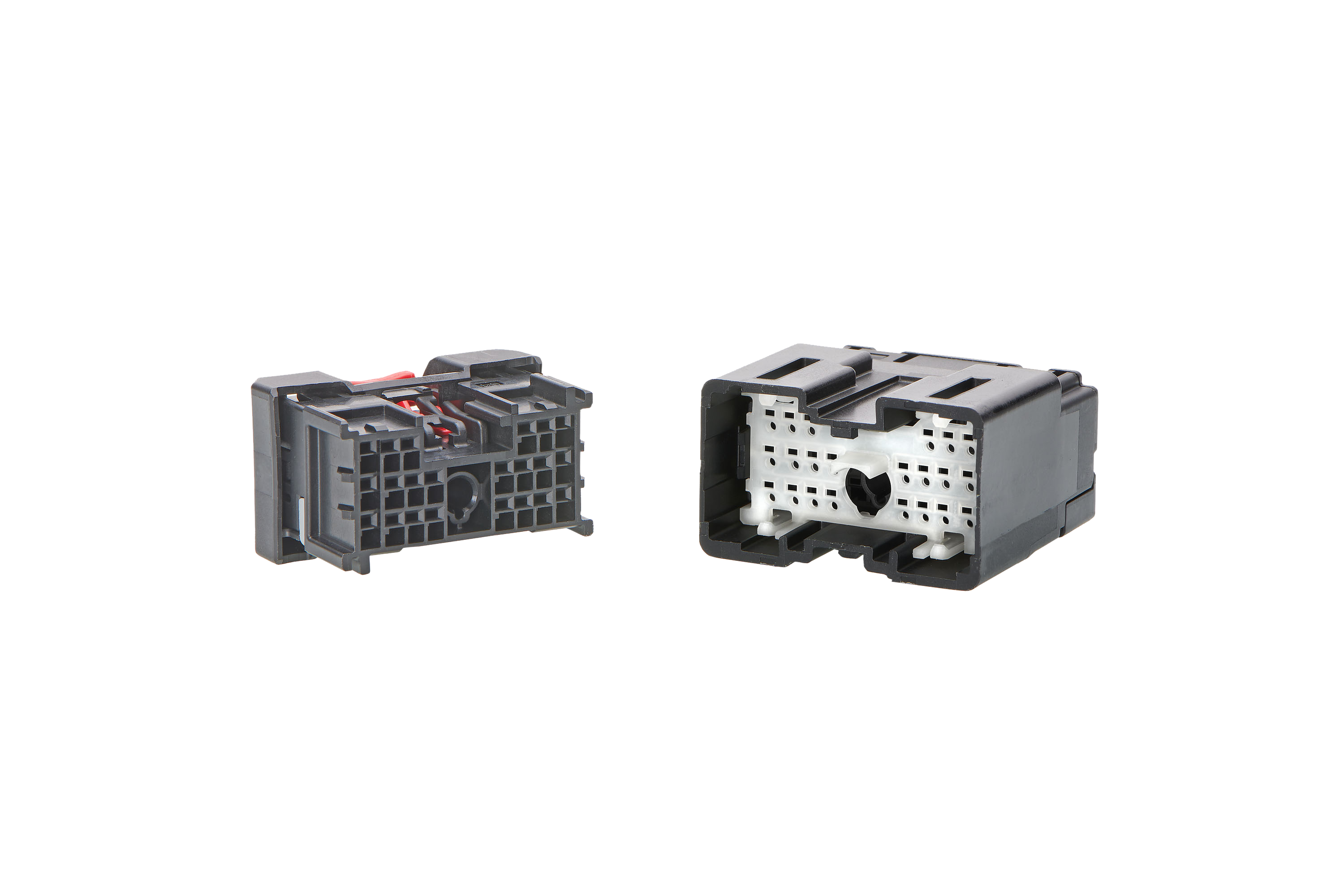
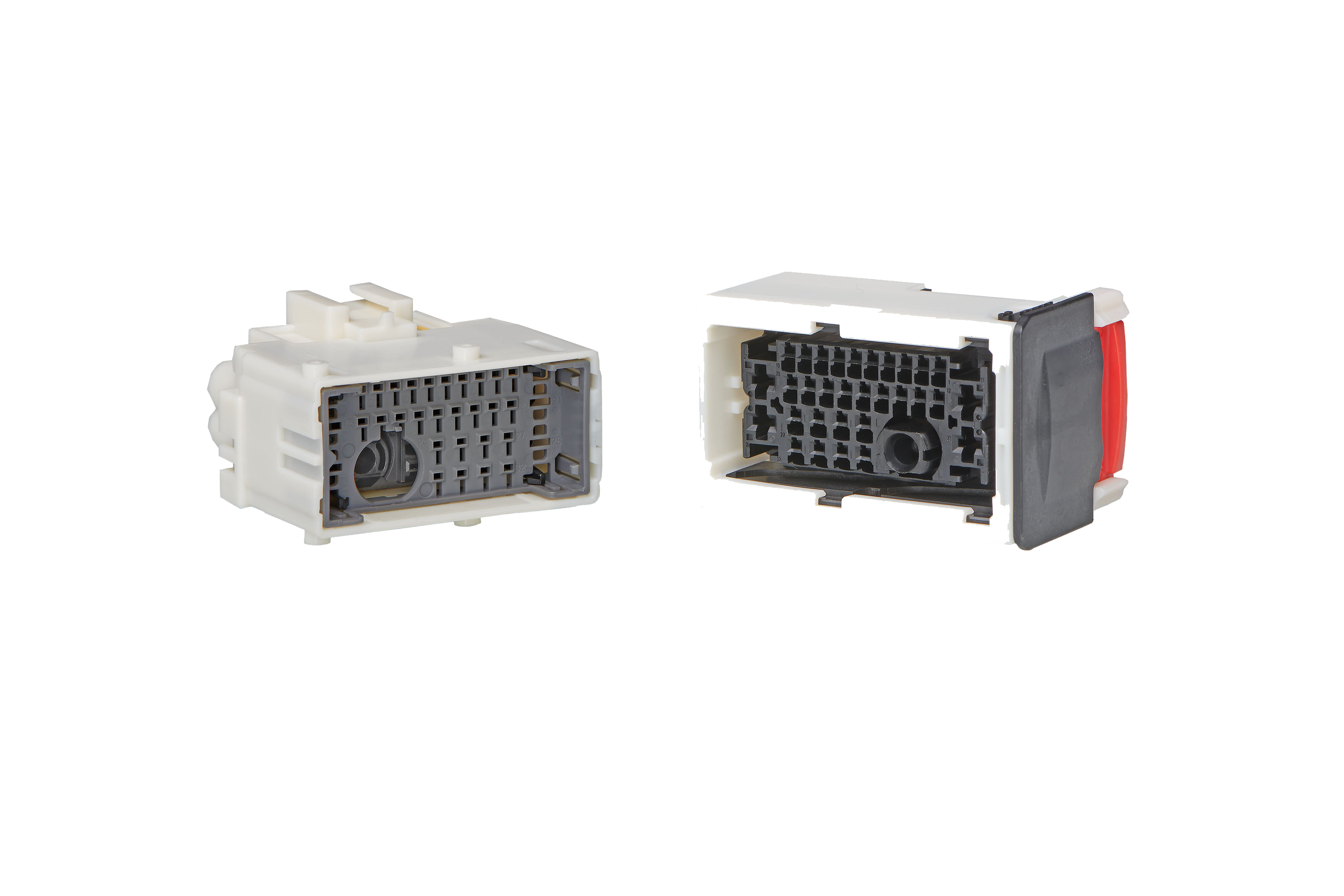
| Configurations | Terminal Sizes | Data Connections |
|---|---|---|
| Sealed or unsealed wire-to-wire and wire-to-board designs; static and modular interfaces | 0.50, 0.64, 1.20, 1.50, 2.80 and 4.80mm | High-Speed FAKRA-Mini (HFM), High-Speed Modular Twisted-Pair Data (H-MTD) |
Today’s automotive platforms face significant challenges as zonal and centralized architectures proliferate. As the complexity of vehicle wiring increases, designers must find alternatives to traditional harnesses that use separate power and signal connectors, increasing size and weight. New electronic control units (ECUs) in rapidly evolving vehicle designs incur additional costs for retooling and validation, calling for more versatile components. Manual harness assembly also introduces variability and delays, making it more important to incorporate automation-friendly designs.
By consolidating multiple connectors into a single interface, designers can reduce wiring harness complexity, save space and reduce weight. Reducing the number of connections also simplifies assembly and minimizes the potential for installation errors, improving overall system reliability. Using connectors designed for automated assembly further enhances reliability and reduces assembly times.
The MX-DaSH system supports zonal and centralized architectures by combining multiple data, signal and power connections into one hybrid interface. This significantly reduces harness weight, packaging size and installation time. Automation-friendly features, such as independent secondary lock (ISL), keying and blade-stabilization options, support faster and more reliable assembly. MX-DaSH Modular Connector variants use configurable cartridges that allow circuit changes without altering the housing, enhancing flexibility and scalability across platforms while minimizing nonrecurring engineering costs.
Multiple circuit counts, power and signal combinations, and static or modular interfaces provide compact, hybrid connectivity for a range of automotive applications needing high-speed signal transmission in both in-cable and I/O applications.
| Configuration | Terminal Sizes | Circuits | Validation Specifications | |
|---|---|---|---|---|
Sealed 10+2 Way and 10+1+1 Way Connectors 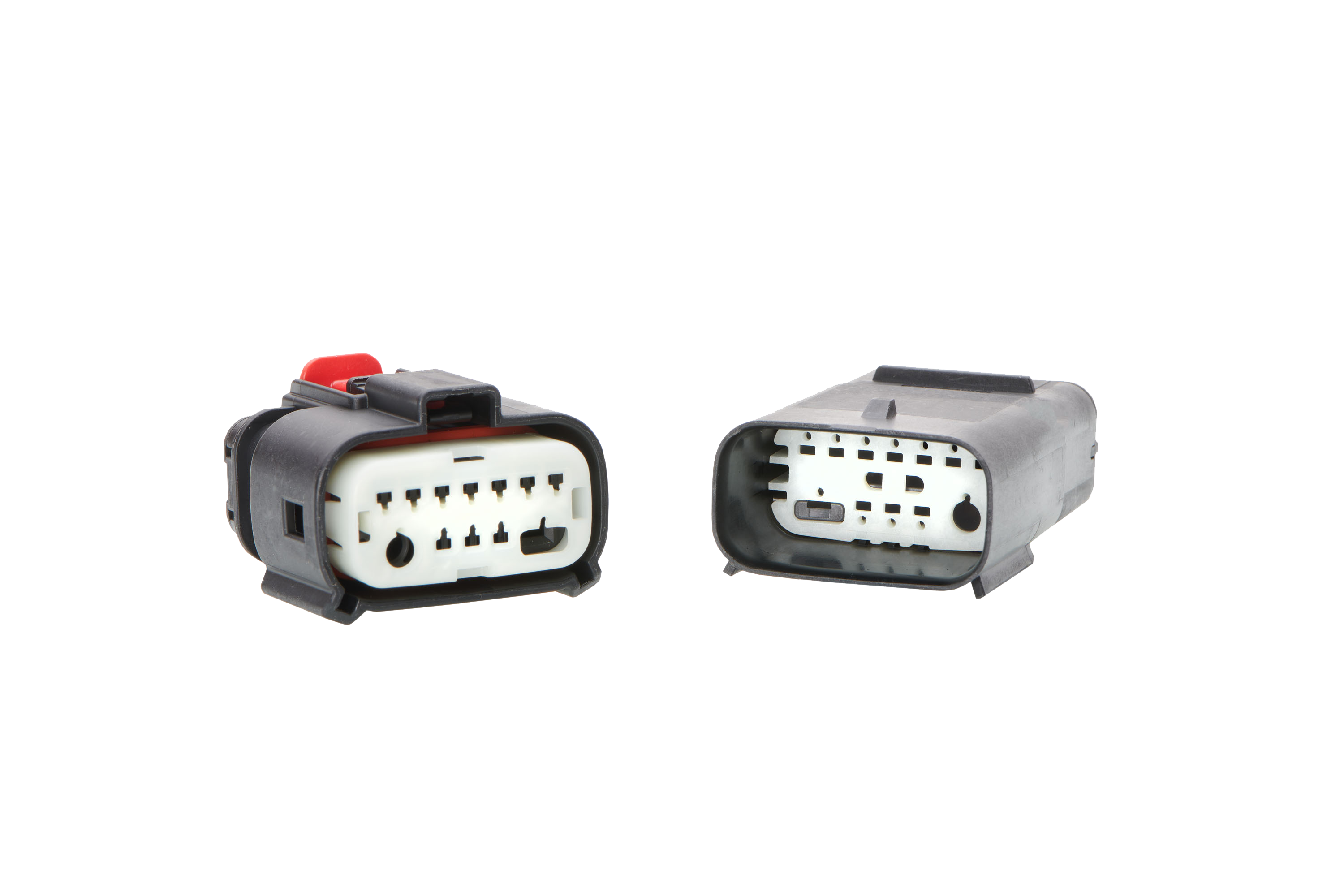 |
Static wire-to-wire | 1.50mm (power and ground circuits) + HFM <1 Gbps | 10 x 1.50mm 2 x HFM or 1 x 2.80mm + 1 x HFM |
USCAR2 rev 8 USCAR17 rev5 USCAR49 T2/V1/S2 |
Sealed 15+1-Way Connectors |
Static wire-to-wire | 1.20mm (power and ground circuits) + HFM <1 Gbps | 15 x 1.20mm 1 x HFM |
GMW3191 T2/V1/S3 USCAR2 rev8 USCAR17 rev5 USCAR49 |
Unsealed 22+1-Way Connectors |
Static wire-to-wire | 1.20mm (power and ground circuits) + HFM <1 Gbps | 22 x 1.20mm 1 x HFM |
USCAR2 rev8 USCAR17 rev5 USCAR49 |
Unsealed 31+1-Way Connectors |
Static wire-to-wire | 1.20mm/2.80mm (power and ground circuits) + HFM <1 Gbps | 19 x 1.20mm (0.75mm2) 8 x 1.20mm (1.50mm2) 4 x 2.80mm 1 x HFM |
B217050 revE (Peugeot) IEC 62153-4-3:2013 (E) IEC 6215-4-7:2015 |
Unsealed Modular Connectors 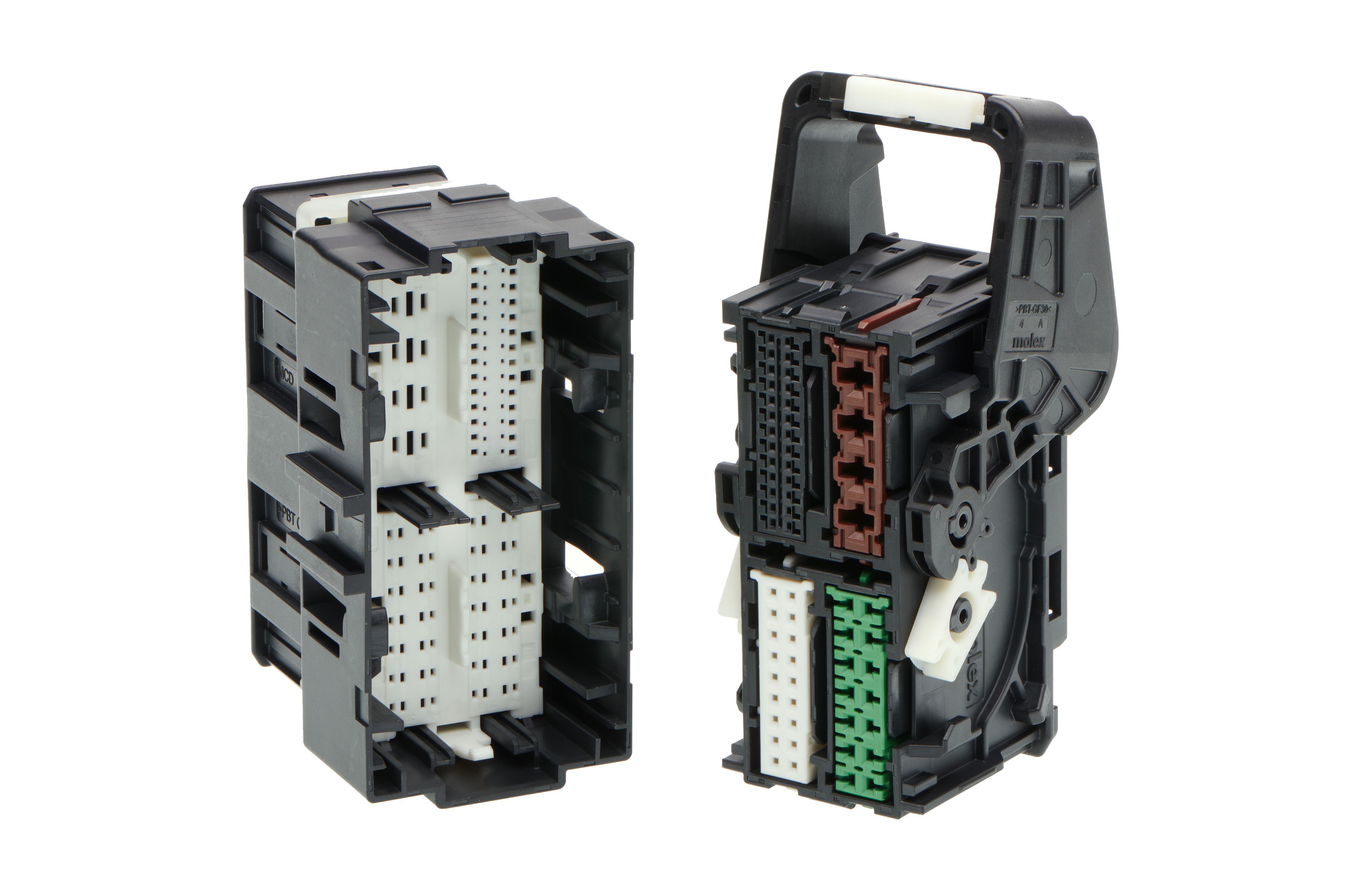 |
Modular wire-to-wire | Four cartridges offering a mix of 0.50, 1.20, 2.80, 4.80 and 6.30mm terminals | 46 to 70 circuits, depending on configuration | USCAR2 rev7 |
Autonomous driving modules
Camera systems
Computing modules
Electrical/electronic architecture components
Gateway/switch modules
GPS devices
High-resolution displays (4K displays)
High-speed cable networking
Infotainment devices
Instrument panel-to-body harness connectors
LiDAR devices
Seat power and signal connections
Sensor-device connectivity
Surround-view cameras
Zonal harnesses
This is not a definitive list of applications for this product. It represents some of the more common uses.
The MX-DaSH system is a modular, hybrid connector system that integrates power, signal and high-speed data into a single, compact interface. It eliminates the need for multiple separate connectors, reducing complexity, space and cost in modern vehicle architectures.
Three main MX-DaSH variants are currently available: MX-DaSH Wire-to-Wire, a sealed or unsealed static hybrid configuration for harness junctions; MX-DaSH Micro, a sealed wire-to-board static interface configuration for high-pin-count zonal and ADAS control unit connections; and MX-DaSH Modular, an unsealed wire-to-wire/wire-to-board cartridge-based system optimized for platform scalability.
Yes, the MX-DaSH system supports high-speed protocols via integrated HFM, H-MTD and Mate-AX cartridges for Ethernet and coaxial data transmission.
Yes, MX-DaSH Connectors come in both sealed and unsealed variants to support cabin and exterior (IP6K9K-rated) environments.
Yes, MX-DaSH Connectors are validated to global automotive standards, including USCAR2, USCAR17, USCAR49, IEC and GB/T, based on the variant and region.
Yes, absolutely. The design includes features like ISL and blade stabilization to enable reliable automation in high-volume production environments.
MX-DaSH Connectors typically operate at 12 to 14V and support current ratings as high as 15.9A (with 2.80mm terminals in modular connectors). HFM or H-MTD data connections can provide up to 25Gbps data transmission speeds.
MX-DaSH Connectors can support a mix of various terminal sizes including 0.50, 0.64, 1.20, 1.50, 2.80, 4.80 and 6.30mm power and signal terminals as well as HFM, H-MTD and Mate-AX high-speed data connections. This versatility enables flexible integration across different circuit loads and signal types.
MX-DaSH Micro and sealed wire-to-wire variants target IP6K9K sealing for use in harsh environments. Modular and unsealed variants are optimized for interior ECU placement where sealing is not crucial. Material selection and gasket design help ensure compliance with industry specifications for thermal, moisture and vibration resistance.
MX-DaSH Connectors are validated for an operating temperature range of -40 to +125°C and storage temperatures up to +85°C. All variants meet automotive-grade temperature cycling and aging requirements per USCAR and GMW standards.
Vibration testing (up to eight hours per axis from 10 to 1,000 Hz with thermal cycling) confirms resistance to micro-cuts and contact degradation. Male blade stabilization and ISL features improve connector robustness under mechanical stress.
MX-DaSH Modular and MX-DaSH Micro versions incorporate fully shielded coaxial and twisted-pair terminals (HFM or H-MTD) with validated shielding effectiveness per IEC 62153-4-3 and -4-7 specifications. Testing and validation for surface transfer impedance and screening attenuation have been completed.
The typical mating forces are <66N for standard modules and <82N for high-speed data modules. Connectors are durability tested for up to 18 cycles with connector position assurance activation and validated with tensile strain tests at 160N without mechanical degradation.
Molex provides full 2D/3D CAD files, pinouts and wiring diagrams via the product detail pages or directly upon request.