A data center technician inspects server equipment between rows of high-density racks.

White Paper

AI-Ready Data Center Dust Center Mitigation: Evaluating VersaBeam EBO Performance

AI data centers change the operational consequences of optical connector reliability. As networks scale to exponentially higher connection counts, even a low contamination-related incident rate can turn an occasional connector problem into costly routine maintenance activity. Connector architecture therefore plays a critical role in managing system-level risk.

Independent Testing Validates VersaBeam EBO for Data Center Dust Mitigation


To evaluate this risk, Molex commissioned independent third-party testing by SGS. The laboratory assessed the Molex VersaBeam Expanded Beam Optical (EBO) connector system using the IEC 60529 IP5X dust exposure standard. Testing included EBO-to-EBO assemblies, EBO-to-MTP assemblies and four 144-fiber VersaBeam receptacles. The high-density connector population alone provided 576 channels.

  • After 16 hours of controlled IP5X dust exposure, all EBO-to-EBO channels remained within specification.
  • Only three of 80 EBO-to-MTP channels and three of 576 channels in the 144-fiber receptacles showed elevated insertion loss.
  • Insertion loss delta and return loss remained within specified criteria.

The results of the SGS testing demonstrate EBO tolerance to dust exposure and highlight an important architectural difference. VersaBeam EBO expands the optical beam across a non-contact interface to reduce sensitivity to particulate contamination. The design eliminates the glass-to-glass compression mechanism that can turn trapped dust into permanent endface damage.

At AI data center scale, these characteristics have consequences beyond connector performance. Reducing contamination-related failures and dependence on inspect-clean-inspect-connect practices can lower operational risk and maintenance effort while supporting faster provisioning. Eliminating physical-contact normal-force requirements allows for much higher fiber-count connector designs, increasing connectivity density as AI optical infrastructure scales.

The Threat of Dust Contamination in AI Data Centers


Dust contamination remains a persistent challenge for optical connections. AI data centers amplify the issue through sheer scale. As optical networks grow to hundreds of thousands of connections, even a low contamination-related incident rate can turn an occasional problem into routine maintenance activity and significant system-level risk.

Microscopic particulate contamination can obstruct the optical path and increase insertion loss. Because a single-mode fiber core measures approximately 9μm in diameter, particles invisible to the naked eye can significantly impair optical performance. At the scale of an AI data center, managing contamination risk grows increasingly important to network reliability. Operators avoid compute impacts such as link -flap outages that have been shown to degrade large-scale AI training performance.

Vulnerabilities of Physical Contact Connectors

Physical-contact connectors are vulnerable to contamination during mating and remating. Technicians therefore inspect and clean optical interfaces during construction, commissioning and ongoing maintenance. The normal force required to maintain physical contact can trap particulate contamination between highly polished fiber endfaces. If a trapped particle is sufficiently hard to resist crushing, the mating force can be transferred through the particle to the glass. Sharp particle geometry can concentrate this force over a very small area, creating high localized stress that can scratch, pit or fracture the fiber endface, potentially extending into the optical core and causing permanent damage.

Once a physical-contact endface is damaged, it cannot be restored by cleaning. The connector or cable assembly must be replaced. At the AI data center scale, managing this risk through inspection, cleaning and careful craft at every connection becomes an increasingly significant operational burden.

Close-up of high-density fiber optic connectors and cables installed in a data center rack.

Industry Standards and Research

Network architects rely on established standards and industry research to evaluate equipment resilience. IEC 60529 provides the standardized IP5X dust exposure methodology used in the VersaBeam test program. To evaluate the specific impact of contamination, the industry relies on the 2022 iNEMI report, Development of Best Practices and Guidelines for the Use of Expanded Beam Connectors in Data Center Applications. The study establishes a relationship between connector architecture and contamination performance. The iNEMI findings identify trapped contamination within physical contact interfaces as a mechanism for permanent endface damage and demonstrate the contamination resilience of expanded beam connector architectures.

The standardized IEC test methodology and the iNEMI research provide the basis for evaluating the VersaBeam EBO dust-exposure results presented here.

Rows of high-density server racks line a modern data center aisle.

IEC 60529 Standardized Testing and Third-Party Validation


To evaluate how VersaBeam EBO performs when exposed to severe dust contamination, Molex commissioned independent third-party testing by SGS using the IEC 60529 IP5X dust-exposure standard. Technicians measured optical insertion loss and return loss before and after exposure to quantify changes in performance.

The test included EBO-to-EBO connector assemblies, five pairs of EBO-to-MTP connector assemblies and four 144-fiber VersaBeam receptacles. The high-fiber-count receptacles provided a particularly large test population. The four 144-fiber connectors represented 576 individual optical channels.

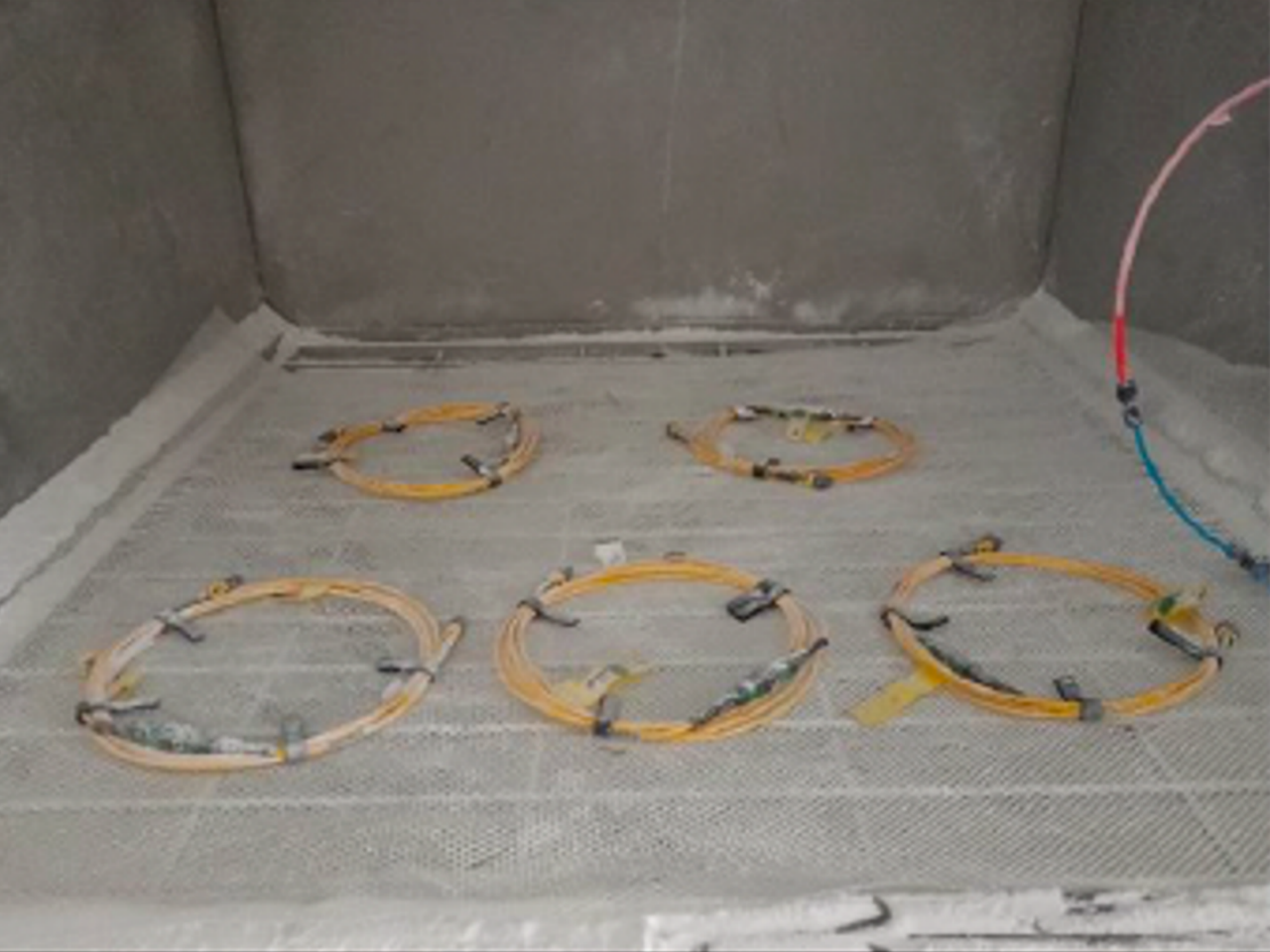
VersaBeam EBO test articles following an eight-hour IEC 60529 IP5X dust-exposure cycle.

Figure 1: VersaBeam EBO test articles following an eight-hour IEC 60529 IP5X dust-exposure cycle. The standardized test maintains a high concentration of fine airborne particulate around the test articles, providing a controlled challenge for evaluating dust ingress and subsequent optical performance.

Measurement Approach and Test Conditions

IEC 60529 IP5X provides a standardized method for evaluating resistance to dust ingress. For the study, SGS used the standard to create a controlled, repeatable high-dust environment and measure VersaBeam EBO performance before and after exposure. Technicians established baseline optical performance and exposed the connectors to a defined dust environment. Subsequent measurements determined any performance changes. All optical connectors remained mated throughout the dust-exposure test.

Technicians measured insertion loss and return loss at 1,310nm before exposure to establish baseline optical performance. The connectors were then subjected to two eight-hour IP5X exposure cycles, totaling 16 hours, using talcum powder with a particle size of less than 75μm. The chamber operated between 18 and 28°C at 25 to 75% relative humidity. The technicians measured optical performance following exposure and visually inspected the connector interfaces at 200X magnification for evidence of contamination or damage.

Comparing Performance: Insertion Loss and Return Loss Degradation


The laboratory compared insertion loss and return loss before exposure and after each dust cycle to determine if contamination significantly degraded optical transmission or caused a lasting change in connector performance.

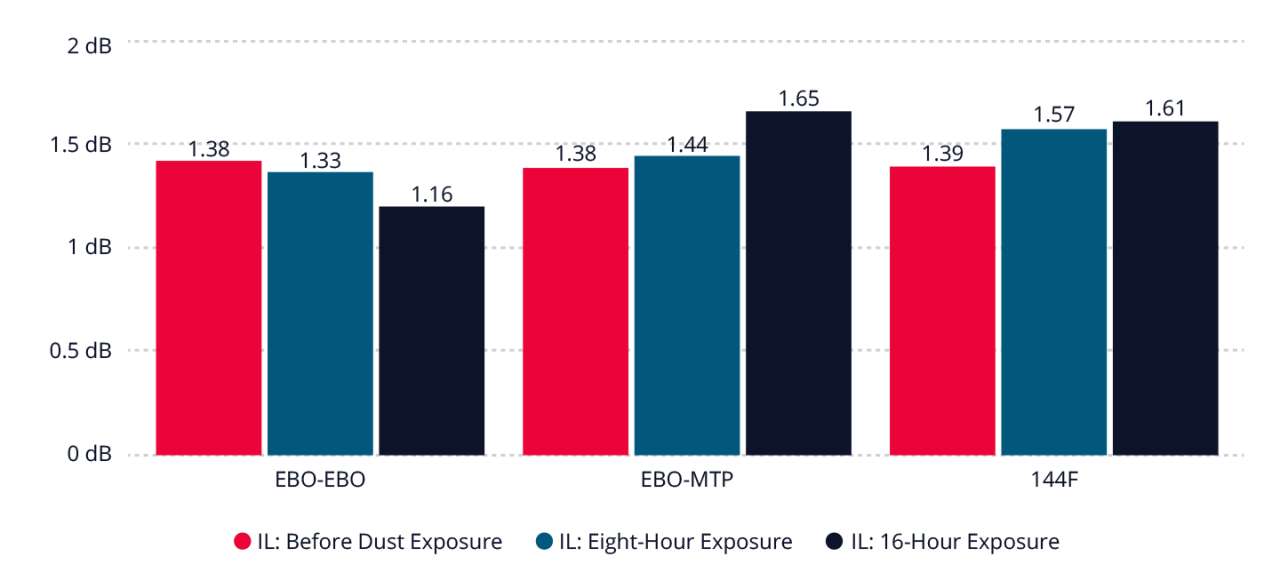
The EBO-to-EBO connectors remained within manufacturer specification limits after the full 16 hours of exposure. For the EBO-to-MTP assemblies, two of 80 channels showed elevated insertion loss after eight hours and three of 80 after 16 hours, with a maximum recorded value of 1.65 dB. Insertion loss delta and return loss remained within specification limits.

The four 144-fiber receptacles provided a much larger population of 576 optical channels. Five channels showed elevated insertion loss after 8 hours, with a maximum of 1.57 dB. After 16 hours, only three of 576 channels showed elevated insertion loss. Insertion loss delta and return loss remained within the specified criteria.

In practical terms, most optical channels continued to perform within specification despite severe IP5X dust exposure. The laboratory compared insertion loss and return loss before exposure and after each dust cycle to determine whether dust exposure degraded optical transmission or produced a lasting change in connector performance.

Overall, the large majority of optical channels continued to perform within specification following the controlled IP5X dust exposure. The limited number of insertion-loss excursions demonstrates that contamination can affect individual channels, while the overall results demonstrate the contamination tolerance of the expanded-beam interface.

Insertion Loss Maximum Values

Chart showing maximum insertion loss measured for EBO-to-EBO, EBO-to-MTP, and 144-fiber VersaBeam test articles before exposure and after the eight-hour and 16-hour IEC 60529 IP5X dust exposure cycles.

Figure 2: Maximum insertion loss measured for EBO-to-EBO, EBO-to-MTP, and 144-fiber VersaBeam test articles before exposure and after the eight-hour and 16-hour IEC 60529 IP5X dust exposure cycles.

Failure Mode Analysis and Visual Inspection

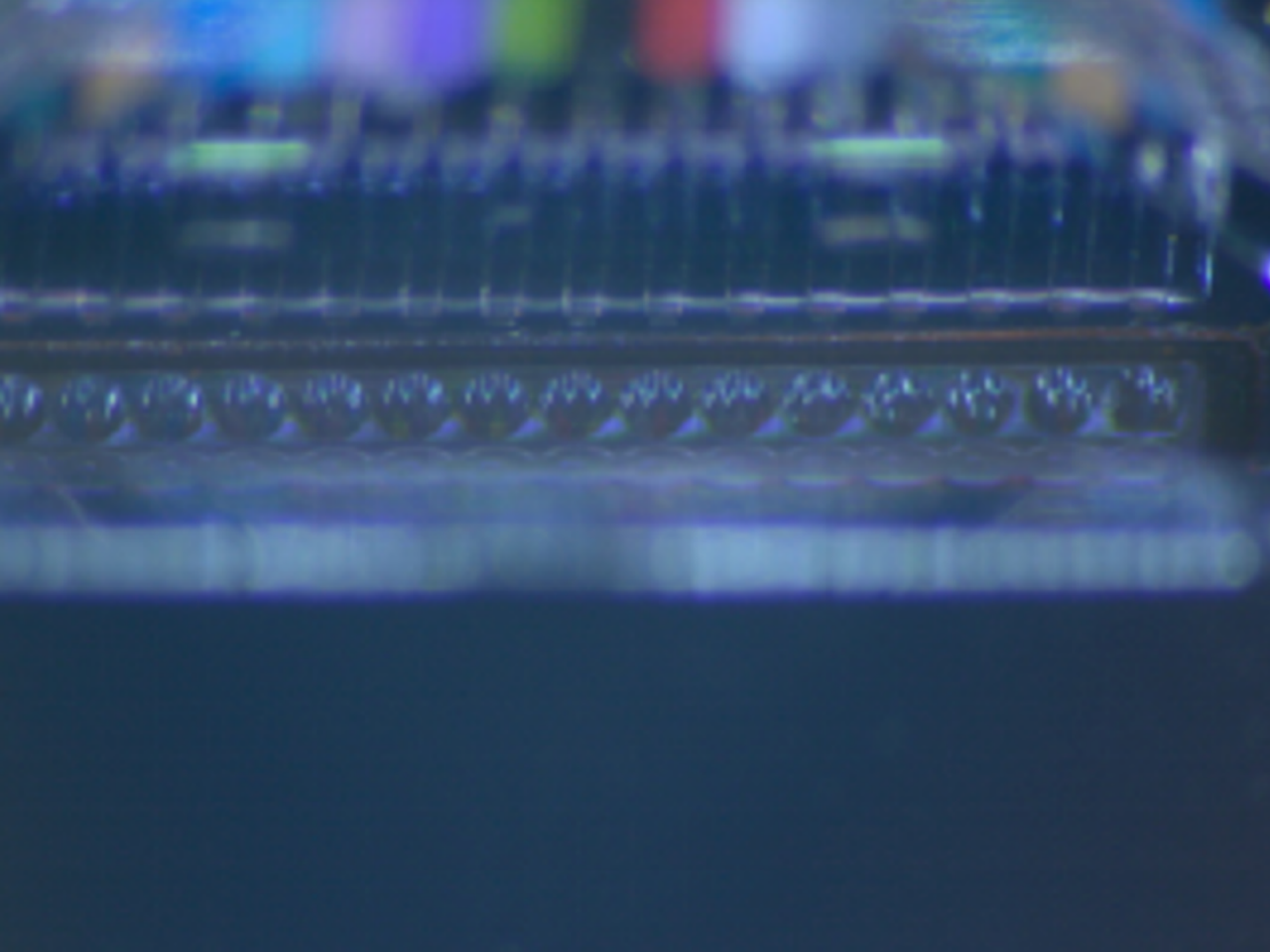
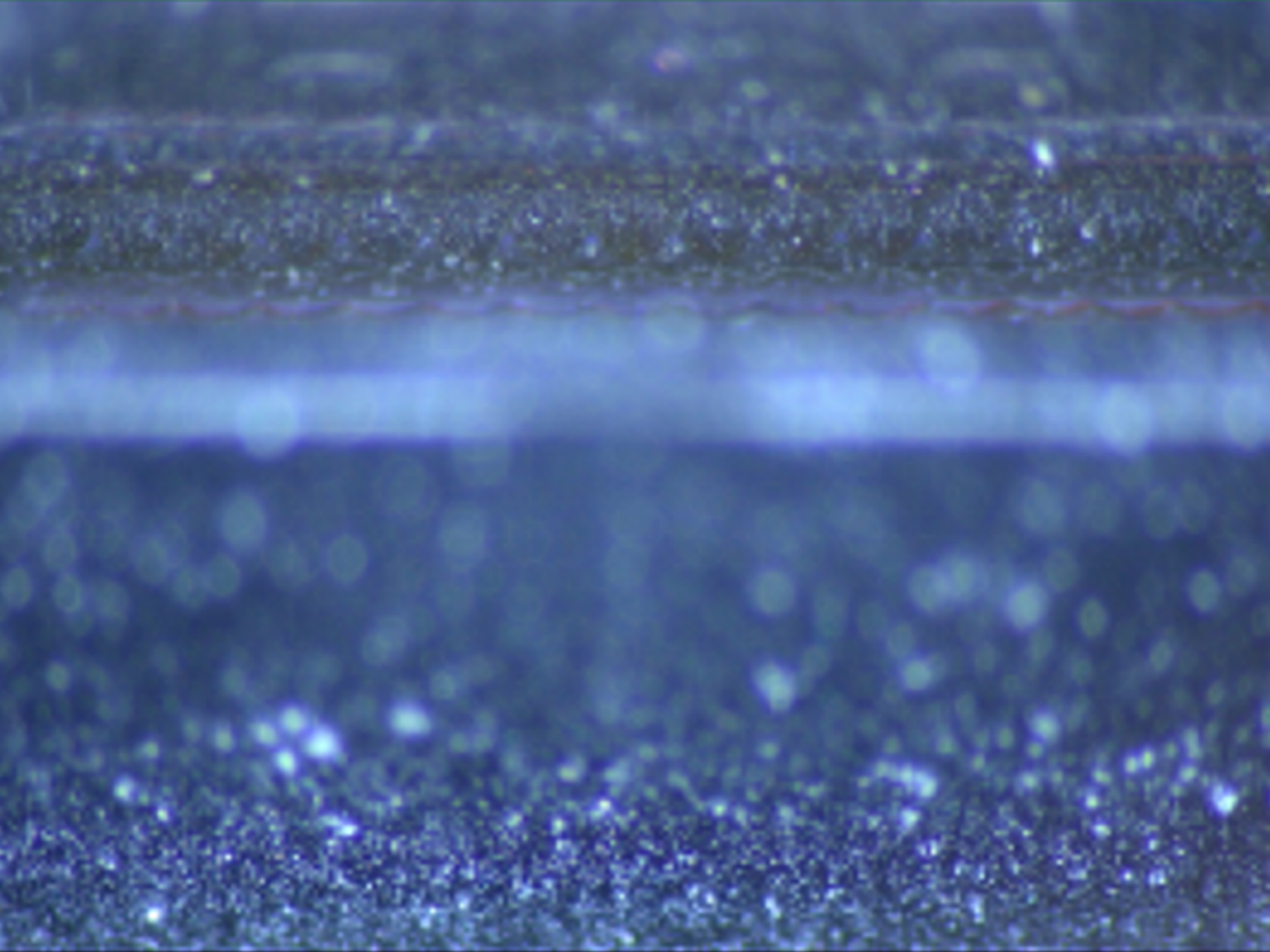
Visual inspection of channels showing elevated insertion loss identified particulate contamination on the optical surfaces. The laboratory evaluated the EBO interfaces and observed what it described as "a small amount of removable dust" on the lens. The observation indicates that the elevated insertion loss was associated with particulate contamination. The visual inspection shows the dust did not cause permanent endface damage (Figure 3).

Before Dust Exposure

Macro image of an EBO-to-EBO connector endface before dust exposure.

After Eight Hours of Dust Exposure

Macro image of an EBO-to-EBO connector endface after eight hours of dust exposure.

Figure 3: Macro images of an EBO-to-EBO connector endface before exposure and after eight hours of dust exposure. The images, paired with the lab’s official finding that a small amount of removable dust has entered the lens, prove the failure mode was recoverable contamination.

The Physics of Contamination Resilience

However low the probability of dust contamination, the significance is not simply whether dust reaches the optical interface, but how the connector responds when it does. EBO expands the optical beam, reducing the effect of individual dust particles on insertion loss, while its non-contact interface eliminates the glass-to-glass contact that can compress trapped particles and permanently damage physical-contact connectors.

Physical-contact MTP connectors use spring force to maintain contact between highly polished optical fiber endfaces. Providing 144 fibers with nine 16-fiber physical-contact MTP interfaces would require approximately 180N (40 lbf) of combined spring force simply to maintain fiber-to-fiber contact. VersaBeam EBO eliminates this normal-force requirement through its non-contact architecture.

Eliminating glass compression removes the normal-force requirement at each fiber interface, reducing a key mechanical constraint on connector fiber count. This enables very high-density interfaces, such as the 144-fiber VersaBeam connector tested in the study, compared with typical 16-fiber MTP/MPO interfaces. The result is the potential for higher-density, more reliable connector designs as optical connectivity scales in AI data centers.

A data center technician services equipment inside a high-density server aisle.

Cleaning, Inspection and Recovery Protocol


The non-contact VersaBeam architecture supports a different approach to inspection and cleaning. VersaBeam connectors are factory-tested and capped, protecting the optical interface until installation. The expanded beam interface is less sensitive to particulate contamination and eliminates the risk of particles being crushed between optical surfaces. The reduced contamination risk allows installation practices to limit dependence on the inspect-clean-inspect-connect discipline required for physical-contact connectors and move toward risk-based inspection and cleaning by exception.

Visual Assessment Guidelines

Visual inspection remains useful with EBO, but its purpose changes. Inspection is performed by exception to identify particulate contamination that could impair optical performance, rather than to confirm a pristine endface before physical contact. When visual assessment is required, operators should use an inspection magnification of 200X to 400X to evaluate the optical interface. When required, operators can remove contamination using standard fiber-optic cleaning methods such as a dry-cleaning tool or wet-to-dry wipe.

Data center technician kneels down to inspect and service the fiber optic connections inside a server rack.

Reducing Total Cost of Ownership Through Field Resilience


High-density optical networks amplify the operational and financial consequences of connector maintenance. When a single facility contains hundreds of thousands of fiber links, inspection, cleaning and remediation performed at individual connections can translate into substantial labor and service costs. Connector architecture therefore becomes an important factor in controlling contamination-related operating costs as network scale increases.

VersaBeam EBO addresses both the probability and consequence of contamination-related events. The expanded-beam interface reduces the probability that dust will impair an optical connection. Simultaneously, the non-contact interface eliminates contamination-related glass compression damage by removing the normal force between mating optical surfaces. When contamination does impair optical performance, the operating response can shift from potential connector or trunk-cable replacement toward inspection and cleaning, reducing service impact and mean time to repair.

The non-contact design also changes provisioning. Physical-contact systems depend on consistent inspect-clean-inspect-connect practices at every mating. Maintaining the discipline becomes increasingly difficult across large installation teams and massive port counts under demanding deployment schedules. Reducing this dependency simplifies installation and maintenance while lowering the risk associated with inevitable process variation. Eliminating physical-contact normal-force requirements also enables much higher fiber counts within an individual connector, increasing connectivity density as AI optical networks scale.

Together, these advantages support faster provisioning and lower operational risk to improve overall network reliability. The resulting reduction in maintenance and service interruption also provides a direct path to lower total cost of ownership.

Solving for Dust Contamination in Data Centers


Operators cannot eliminate dust from data centers. However, engineers can design the risk out of the optical interface. The IEC 60529 IP5X test results demonstrate VersaBeam EBO tolerance to severe particulate exposure. The expanded-beam, non-contact architecture addresses the two principal contamination mechanisms. The design mitigates optical impairment from particles in the light path and prevents contamination-related glass compression damage.

When evaluating the threat of dust in data centers, the importance of the architectural difference increases with scale. AI data centers rely on unprecedented volumes of optical connections. In these environments, occasional connector problems can become routine operational events, and dependence on consistent inspection and cleaning practices becomes increasingly difficult to sustain. Moving contamination risk management from dependence on field process into the connector design provides a more scalable approach to network reliability.

VersaBeam EBO therefore addresses dust not simply as a maintenance problem, but as an infrastructure design problem. Reducing contamination sensitivity and eliminating contamination-related glass compression damage helps design out a source of operational risk as optical connectivity scales in AI data centers.

The VersaBeam Advantage

The Molex VersaBeam EBO connector system combines dust contamination resilience with very high fiber density and a simpler operating model. The expanded-beam, non-contact design reduces the impact of dust, eliminates contamination-related glass compression damage and reduces dependence on inspect-clean-inspect-connect practices at every mating. Removing the normal-force constraint of physical-contact interfaces also enables much higher fiber counts and greater freedom in connector design. The technology allows Molex to develop new high-density connector forms optimized for the packaging and connectivity requirements of modern AI infrastructure, as evidenced by the 144-fiber VersaBeam connectors tested in the study.

These capabilities support faster provisioning and lower maintenance effort to reduce operational risk and improve network reliability. VersaBeam EBO provides a platform for designing out many of the consequences of dust while allowing optical connectivity and connector density to scale with the demands of next-generation networks.

Molex Expanded Beam connector and cable assembly.

High-Density Optical Solutions for Data Centers

To learn more about high-density optical solutions designed for effective data center dust mitigation, explore VersaBeam Expanded Beam Optical Connectors and Molex fiber optic data center applications.

Fiber Optic Connector in an AI data center.